
Complete Guide to Mold in Air Ducts Prevention Remediation Dallas TX
Mold growing inside commercial air ducts is one of the most persistent and costly HVAC challenges that Dallas, TX building owners face. The combination of Gulf-influenced humidity, relentless summer heat, and hard-working cooling systems creates ideal conditions for moisture buildup deep within ductwork — and where moisture lingers, mold follows. In this comprehensive guide, Clean Air Dallas Pro breaks down how mold develops in commercial air ducts, how to recognize it early, the critical difference between standard cleaning and professional remediation, and what Dallas property managers can do to prevent it from coming back.
Estimated reading time: 14 minutes
Key Takeaways
- Dallas’s high humidity and extended cooling seasons make commercial ductwork especially vulnerable to condensation and mold growth.
- Standard duct cleaning alone cannot resolve active mold — professional remediation that addresses the moisture source is required for lasting results.
- Porous duct materials like fiberglass liner and duct board that become moldy must be removed and replaced, per EPA guidance.
- Monthly drain pan inspections and maintaining indoor humidity between 30–50% are among the most effective prevention strategies.
- Texas law requires licensed mold remediators for projects exceeding state-defined thresholds, with separate licensing for assessment and remediation.
- Early professional inspection saves Dallas businesses significant money compared to repeated surface cleanings that fail to fix the root cause.
- Why Does the Dallas Climate Put Commercial HVAC Systems at Risk for Mold?
- How Do You Identify Mold Growth Inside Commercial Air Ducts?
- A Common Mistake: Assuming Standard Duct Cleaning Will Solve a Mold Problem
- Cleaning Versus Remediation: What Each Process Actually Involves
- How Professional Air Duct Mold Remediation Works in Dallas
- What Triggers Mold to Keep Coming Back in Commercial Ductwork?
- Practical Prevention Strategies for Dallas Building Managers
- When Should a Dallas Business Call for Professional Inspection?
- Texas Compliance: How State Law Defines Mold Remediation
- Comparing DIY Prevention Efforts to Professional Maintenance
- How Indoor Air Quality Testing Supports Mold Prevention
- What Does Mold Remediation Typically Cost for Dallas Commercial Properties?
- Frequently Asked Questions
- Ready to Protect Your Dallas Property
Why Does the Dallas Climate Put Commercial HVAC Systems at Risk for Mold?
Dallas sits in a region where Gulf moisture drives extended periods of stifling humidity, especially from late spring through early fall. When warm, moisture-laden outdoor air meets the cold surfaces inside an air-handling unit or supply ductwork, condensation forms quickly. In commercial buildings that run cooling systems for long hours, this condensation can accumulate on coils, drain pans, duct liners, and insulation.
Surface dirt or dust inside ducts is not the same as mold growth. Dust collects naturally and can usually be addressed through routine cleaning. Mold, by contrast, indicates an active moisture problem that must be resolved at the source. The CDC notes that any mold growing in buildings points to a water or moisture issue that needs prompt attention, not just surface wiping. For Dallas commercial properties, this distinction is critical because it determines whether you need standard duct maintenance or a more involved remediation process.
How Do You Identify Mold Growth Inside Commercial Air Ducts?
Facility managers often discover mold only after occupants begin complaining. By that point, the contamination may have been spreading through the air distribution system for weeks. Recognizing the signs early helps limit the scope of remediation and reduces disruption to building operations.
Visible and Sensory Warning Signs
Dark or discolored patches around supply grilles, return vents, or on the surfaces of the air handler are the most obvious visual indicators. A persistent musty smell that intensifies when the HVAC system cycles on is another common clue. In some cases, occupants report a stale or earthy odor that lingers regardless of cleaning efforts in the occupied space. These sensory signals often point to contamination deeper inside the ductwork rather than just at the visible surface.
Hidden Mold in Condensate Pans and Duct Liners
Not all mold is visible from the outside. According to the EPA’s guidance on commercial-building mold remediation, condensate drain pans and porous duct liners are among the most common hidden mold locations. Standing water in a drain pan, even a small amount, provides the sustained moisture that mold requires. Porous duct board or fiberglass liner that has absorbed moisture can harbor mold below the surface, making it impossible to detect without a targeted inspection. When complaints are recurring or a musty smell persists despite visible cleaning, a professional assessment of these concealed areas is typically the practical next step.
A Common Mistake: Assuming Standard Duct Cleaning Will Solve a Mold Problem
One of the most frequent errors Dallas property managers make is treating active mold growth with a routine duct cleaning and expecting the issue to resolve permanently. Standard duct cleaning removes dust, debris, and surface contaminants from the interior of the ductwork. It does not address the moisture source fueling the mold, it does not involve containment to prevent spore dispersal during the process, and it does not include verification that the problem has been fully resolved.
The EPA states clearly that wet or moldy porous duct materials, such as fiberglass insulation or duct board, cannot be effectively cleaned and should be removed and replaced. If the underlying moisture issue remains unresolved, mold will return regardless of how thoroughly the visible growth was scrubbed away. This is the core distinction between cleaning and remediation, and it matters both for the health of the building and for regulatory compliance in Texas.
Concerned about mold in your commercial ductwork? Don’t wait for the problem to spread.
Cleaning Versus Remediation: What Each Process Actually Involves
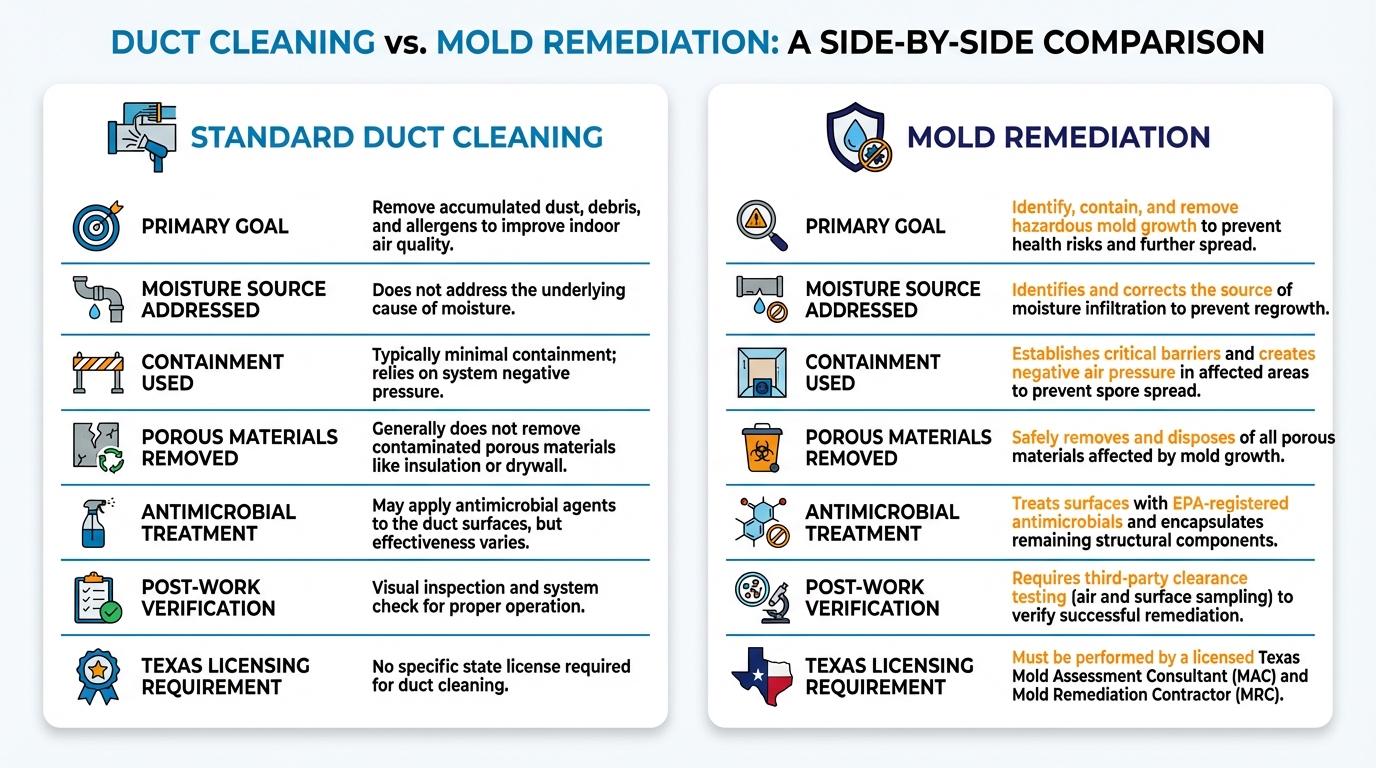
| Factor | Standard Duct Cleaning | Mold Remediation |
|---|---|---|
| Primary goal | Remove dust and debris from duct surfaces | Eliminate mold contamination and prevent recurrence |
| Moisture source addressed | No | Yes — identified and corrected first |
| Containment used | Typically not | Yes — to prevent spore dispersal |
| Porous materials removed | Not standard practice | Wet or moldy insulation and duct board replaced |
| Antimicrobial treatment | Optional add-on | EPA-registered products applied as part of the process |
| Post-work verification | Visual check | May include clearance testing or documentation |
| Texas licensing requirement | General HVAC or cleaning contractor | Licensed mold remediator for projects above state thresholds |
Understanding this distinction helps property managers avoid paying for a service that cannot fully resolve the issue, while also ensuring the right professional is handling the work.
How Professional Air Duct Mold Remediation Works in Dallas
A reliable remediation process follows a logical sequence designed to address both the contamination and its cause. Skipping or compressing steps is one of the main reasons mold returns after treatment.
Assessment and Moisture Source Identification
The process begins with a thorough inspection of the HVAC system, including the air handler, coils, condensate drain lines, duct connections, and insulation. The goal is to locate where moisture is entering or accumulating. Common culprits in Dallas commercial buildings include clogged or improperly sloped drain pans, condensation on poorly insulated ductwork, rooftop unit leaks, and high indoor humidity levels that overwhelm the dehumidification capacity of the cooling system.
Containment, Removal, and Cleaning
Once the moisture source is identified, the affected section of the duct system is isolated using physical barriers and negative air pressure to prevent spores from spreading into occupied spaces during the work. Porous materials with active mold growth are removed and replaced. Hard, non-porous duct surfaces are cleaned using methods consistent with EPA guidance. This is where professional air duct cleaning services integrate into the broader remediation effort, ensuring thorough removal of contaminants from the ductwork interior before sanitization is applied.
Drying, Repair, and Prevention Measures
After cleaning and removal are complete, the affected areas are dried thoroughly. Replacement insulation is installed, damaged duct sections are sealed or replaced, and the moisture source is corrected. Without this final step, the remediation provides only temporary relief. Proper drying and moisture correction are what separate a lasting solution from a recurring problem.
What Triggers Mold to Keep Coming Back in Commercial Ductwork?
When mold returns within weeks or months of a previous treatment, the underlying cause was almost certainly not resolved. The most common reasons for recurrence in Dallas commercial properties include drain pans that continue to hold standing water due to improper slope, ductwork that lacks adequate insulation and develops condensation during cooling cycles, building envelope issues that allow humid outdoor air to infiltrate, and HVAC systems that are undersized for the cooling load and therefore cannot adequately dehumidify the air.
Each of these scenarios allows moisture to re-enter the duct system and restart the mold growth cycle. A professional evaluation that looks beyond the visible mold and addresses the full moisture pathway is the most reliable way to break this pattern. Clean Air Dallas Pro approaches duct mold issues by evaluating the entire air distribution system rather than treating only the visible contamination, which helps Dallas business owners avoid repeated service calls for the same problem.
Tired of mold coming back after cleaning? Let us find and fix the root cause.
Practical Prevention Strategies for Dallas Building Managers
Prevention costs significantly less than remediation, both in direct expense and in operational disruption. The U.S. Department of Energy identifies moisture control as the single most effective way to prevent mold growth in buildings. For Dallas commercial HVAC systems, this translates into several specific actions.
| Prevention Action | What It Addresses | Recommended Frequency |
|---|---|---|
| Inspect and clean condensate drain pans | Standing water that feeds mold growth | Monthly during cooling season |
| Verify drain line slope and flow | Blocked or slow drainage | Quarterly |
| Replace air filters | Dust buildup that acts as mold food source | Per manufacturer schedule or more often in high-dust environments |
| Check duct insulation condition | Condensation on cool duct surfaces | Annually or after any water event |
| Monitor indoor relative humidity | Humidity above 60% promotes mold | Continuously during occupied hours |
| Inspect coils and air handler interior | Organic buildup on cooling coils and housing | Semi-annually |
| Seal duct joints and connections | Air leaks that pull in unconditioned humid air | During routine HVAC maintenance |
Keeping indoor relative humidity between 30 and 50 percent is the target range recommended by most building science authorities. In Dallas, where outdoor humidity regularly exceeds 70 percent during summer months, achieving this requires a properly sized and well-maintained cooling system working in coordination with sealed ductwork and adequate insulation.
When Should a Dallas Business Call for Professional Inspection?
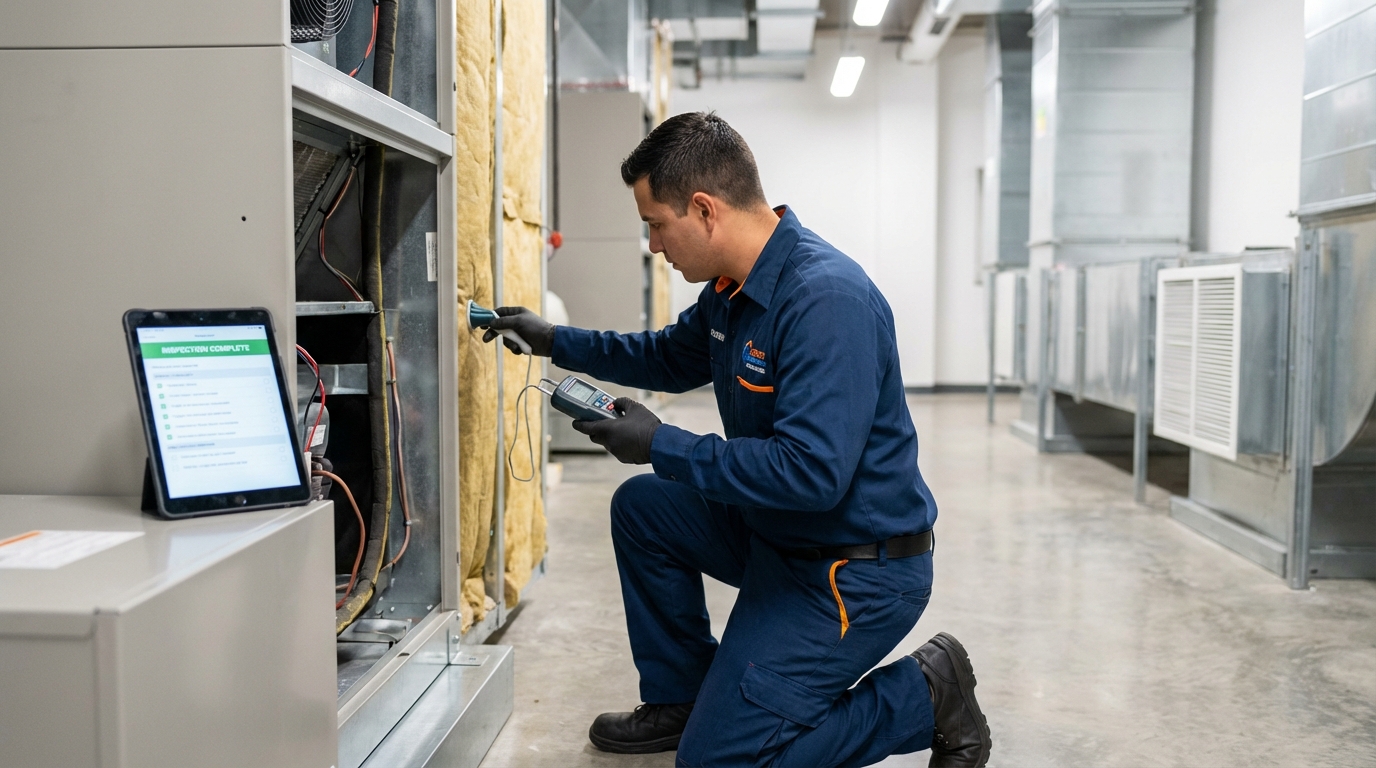
Not every musty smell means there is mold inside the ductwork, and not every dark spot on a vent grille is active mold. However, several scenarios strongly suggest that a professional inspection is warranted rather than a wait-and-see approach. These include persistent occupant complaints about air quality or odors that do not resolve after basic cleaning, visible discoloration inside the air handler or on accessible duct surfaces, any history of water intrusion near the HVAC system from roof leaks or plumbing issues, and systems that have not been professionally inspected or cleaned in several years.
A professional inspection typically includes a visual assessment of accessible ductwork and HVAC components, moisture readings at key points, and documentation of conditions. Clean Air Dallas Pro provides detailed inspection services that help Dallas property managers understand exactly what is happening inside their duct systems before committing to any remediation scope, so the response is proportional to the actual problem.
Texas Compliance: How State Law Defines Mold Remediation
Texas regulates mold remediation through the Texas Department of Licensing and Regulation. Under state law, mold remediation includes not only the physical removal and cleaning of mold-contaminated materials but also preventive activities taken to ensure mold does not return. The TDLR requires notification for remediation projects that exceed certain square-footage thresholds, and projects above those thresholds must be performed by licensed remediators.
For Dallas commercial building owners, this means that what might seem like a straightforward duct cleaning project could actually fall under formal remediation requirements depending on the extent of contamination. Proper documentation, including pre-remediation assessment and post-remediation verification, protects building owners from liability and demonstrates due diligence to tenants, insurers, and regulators. Working with a service provider that understands these Texas-specific requirements helps ensure the project is handled correctly from the start.
Comparing DIY Prevention Efforts to Professional Maintenance
Building maintenance teams can handle many day-to-day prevention tasks like filter changes, visual drain pan checks, and thermostat monitoring. However, several aspects of mold prevention and early detection require professional equipment and training. Video inspection of interior duct surfaces, moisture mapping around concealed components, coil cleaning that requires partial system disassembly, and evaluation of duct insulation integrity are all tasks that go beyond routine in-house maintenance capabilities.
Clean Air Dallas Pro bridges this gap for Dallas businesses by providing thorough duct system assessments and maintenance services that complement what your in-house team already does. This layered approach, where routine tasks are handled internally and deeper inspections and cleaning are performed by a professional service, is the most practical and cost-effective model for long-term mold prevention in commercial HVAC systems.
How Indoor Air Quality Testing Supports Mold Prevention
Air quality testing is not always necessary, and the CDC notes that routine air sampling for mold is generally not recommended during standard building evaluations. However, there are situations where testing adds real value. If occupants report health-related complaints, if remediation has been completed and verification is needed, or if a property is being evaluated for purchase or lease, indoor air quality testing can provide objective data about airborne conditions.
Testing can measure particulate levels, identify specific mold types present in the air, and compare indoor readings to outdoor baseline conditions. This data helps property managers make informed decisions about whether remediation is needed, whether a completed project was successful, and whether ongoing monitoring is warranted. It transforms what might otherwise be a subjective complaint into a documented, measurable condition.
What Does Mold Remediation Typically Cost for Dallas Commercial Properties?
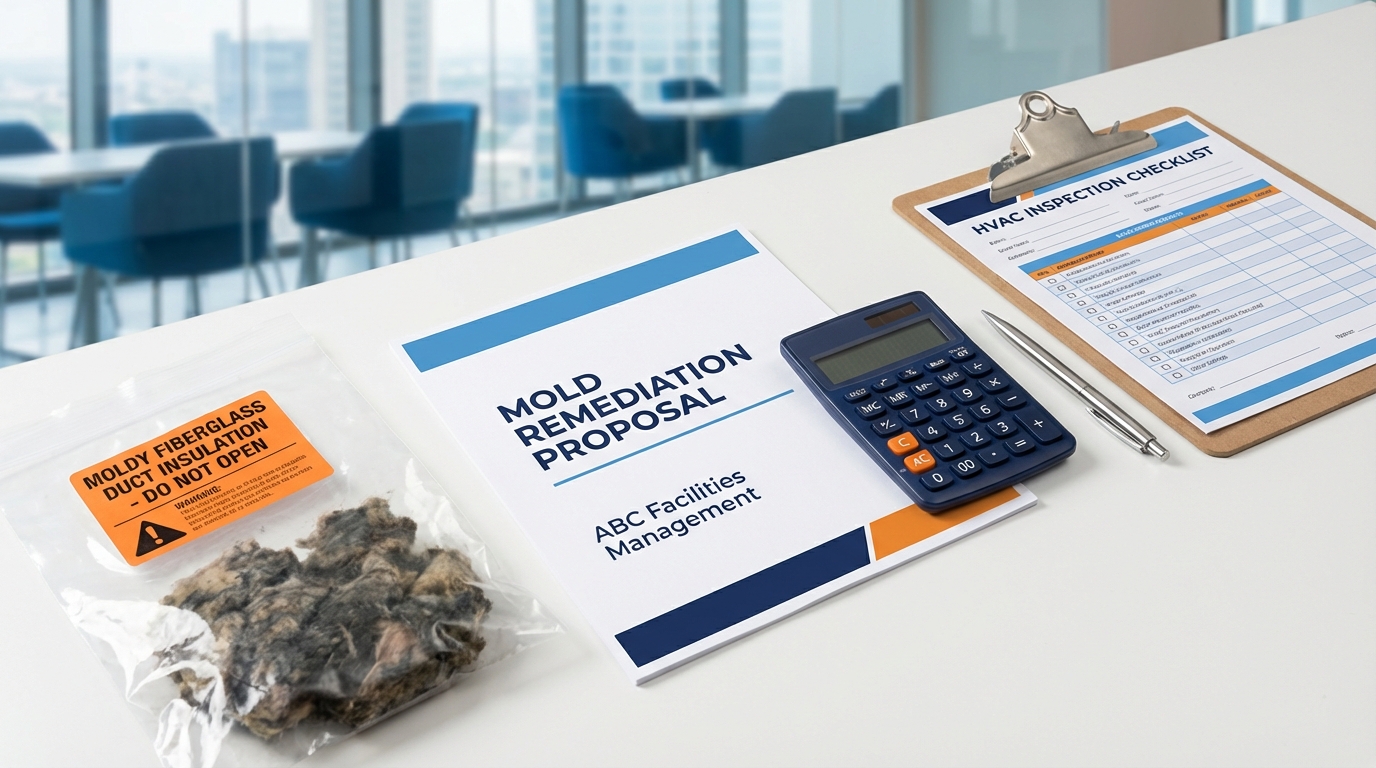
There is no single answer to this question because costs depend on several variables specific to each building. The size of the affected area, the type of duct material involved, the accessibility of the contaminated sections, whether porous materials need full replacement, the complexity of the moisture source, and whether formal Texas licensing and documentation requirements apply all influence the final cost.
Small-scale contamination limited to accessible duct surfaces and a drain pan may be resolved with a targeted cleaning and moisture correction at a relatively modest cost. Larger projects involving extensive duct liner replacement, containment setups, and post-remediation verification will naturally cost more. The most important cost factor, however, is getting the diagnosis right the first time. Paying for repeated surface cleanings that do not resolve the moisture source is more expensive in the long run than a single, properly scoped remediation project.
Want to know what remediation would cost for your building? Get a no-obligation estimate today.
Frequently Asked Questions About Mold in Air Ducts in Dallas
+
Mold in air ducts can affect indoor air quality by distributing spores through the HVAC system into occupied spaces. OSHA identifies mold as a common factor in indoor air quality complaints in workplaces. The severity of the impact depends on the type and extent of mold, the sensitivity of individual occupants, and how long the exposure continues. Professional assessment is the best way to evaluate the risk for a specific building.
+
Yes. Condensation forms when humid air contacts cool duct surfaces, coils, or other HVAC components. In Dallas, where summer humidity is consistently high, this is one of the most common moisture sources for duct-related mold. Proper insulation, sealed duct joints, and well-maintained drain systems help minimize condensation buildup.
+
Not always. Hard, non-porous duct surfaces such as sheet metal can usually be cleaned effectively. However, porous materials like fiberglass duct liner or duct board that have become wet and moldy typically cannot be fully cleaned and should be removed and replaced, according to EPA guidance.
+
There is no single mandated schedule, but an annual professional inspection of the duct system and air handler is a reasonable baseline for most Dallas commercial properties. Buildings with a history of moisture problems, older HVAC systems, or high-occupancy environments may benefit from more frequent checks, particularly before and after the peak cooling season.
+
A mold assessment is the evaluation and documentation phase, where a professional identifies the presence, type, and extent of mold and the moisture conditions causing it. Mold remediation is the physical process of removing contamination, correcting the moisture source, and restoring affected materials. Under Texas law, these functions are defined and licensed separately to protect consumers.
+
If mold returns after cleaning, the underlying moisture source was not resolved. Common causes include drain pans with improper slope that hold standing water, poorly insulated ductwork that develops condensation, building envelope leaks that allow humid air infiltration, and undersized HVAC systems that cannot adequately dehumidify. A professional evaluation of the complete moisture pathway is needed to break the cycle.
Ready to Protect Your Dallas Property From HVAC Mold Issues?
If your commercial building in Dallas has persistent air quality complaints, visible signs of moisture around vents, or an HVAC system that has not been professionally inspected recently, the practical next step is a thorough evaluation of your duct system and its moisture control points. Addressing mold early, before it spreads through the air distribution network, protects occupant health, supports commercial HVAC maintenance goals, and avoids the higher costs of large-scale remediation.
What would a professional inspection reveal about the condition of your ductwork right now? Contact Clean Air Dallas Pro to schedule an assessment, ask about mold prevention and remediation services, or request a free estimate for your Dallas commercial property.
What Our Dallas Customers Say
“I had the pleasure of hiring this exceptional firm to clean my air ducts, and I am really pleased with the outcomes. Their team’s expertise in air duct cleaning is unparalleled. My indoor air quality has improved significantly as a consequence of their painstaking efforts.”
— Laura S. Turner
“This company was my first choice while searching for ‘air duct cleaning near me’. They are experts at cleaning ducts. Their versatility and dependability are unparalleled.”
— Camille Pearce
“My expectations were surpassed by Clean Air Dallas Pro’s vent cleaning service. The crew completed the task with efficiency, and the procedure ran smoothly from beginning to end. My HVAC system’s efficiency and airflow started to alter right away.”
— Rickey Williams

Clean Air Dallas Pro Team
Clean Air Dallas Pro provides professional air duct cleaning, mold remediation, and HVAC maintenance services for commercial and residential properties throughout Dallas, TX. Our experienced team is committed to improving indoor air quality and helping building owners protect their investments. Located at 2710 Guillot St, Dallas, TX 75204, we are ready to help. Call us at (214) 935-5058 or email [email protected].