
The Essential Allergen Dust Control Home Air Duct Guide Dallas
If you live in Dallas and notice that your home feels dusty no matter how often you clean, or that allergy symptoms seem worse indoors than outside, you are not alone. The combination of North Texas pollen seasons, year-round HVAC use, pet dander, and microscopic dust mites creates an indoor environment where allergens can quietly accumulate inside ductwork, on surfaces, and in the air you breathe every day. This allergen dust control home air duct guide for Dallas homeowners walks through the practical steps, common mistakes, and professional solutions that can help you take meaningful control of your indoor air quality.
Estimated reading time: 14 minutes
Key Takeaways
- Dallas homes face a diverse mix of indoor allergens including dust mites, mold spores, pet dander, pollen, and cockroach debris that accumulate in ductwork and on surfaces year-round.
- Persistent dust is usually a systemic HVAC and ductwork issue, not a reflection of how well you clean surfaces.
- No single action eliminates indoor allergens completely; effective control layers daily habits, proper filtration, humidity management, and periodic professional duct maintenance.
- Upgrading to a MERV-13 filter and replacing it every 30 to 90 days based on household conditions can significantly reduce airborne allergens.
- Professional air duct cleaning is most beneficial when there is visible buildup, musty odors, post-renovation dust, or worsening allergy symptoms tied to HVAC operation.
- What Indoor Allergens Are Most Common in Dallas Homes?
- Why Is My House So Dusty Even After Cleaning?
- Does Air Duct Cleaning Help with Allergies?
- A Comparison: Surface Cleaning vs. System-Level Allergen Control
- How Often Should Air Ducts Be Cleaned in Dallas?
- Can Dirty Air Ducts Make Allergies Worse?
- What Is the Best Air Filter for Allergy Control at Home?
- Three Mistakes Dallas Homeowners Make When Trying to Reduce Allergens
- How Do I Keep Pollen Out of My House in Dallas?
- Can Pets Make Indoor Allergens Worse?
- Do Air Purifiers Help with Dust and Allergens?
- What Should Homeowners Prioritize First to Reduce Allergens?
- When Should a Homeowner Suspect the Air Ducts Are Part of the Problem?
- Advanced Techniques: Duct Sealing, HEPA Filtration, and Insulation
- How Can Dallas Homeowners Build an Allergen-Reduction Plan That Actually Works?
- What Our Customers Say
- Find Us
- Frequently Asked Questions
What Indoor Allergens Are Most Common in Dallas Homes?
Dallas homes face a particularly diverse mix of indoor allergens. According to the EPA’s guidance on biological pollutants, the most significant contributors to poor indoor air quality include dust mites, mold spores, pet dander, pollen, and cockroach debris. In North Texas, the warm and humid climate extends the growing season for many outdoor plants, which means pollen can enter homes for much of the year through doors, shoes, clothing, and even pet fur.
What makes the situation trickier is that these allergens rarely come from a single source. Dust mites thrive in bedding and upholstery. Pollen settles on floors and gets drawn into return vents. Pet dander clings to fabrics and circulates through ductwork every time the HVAC system cycles on. Understanding that allergen buildup is a system-wide issue — not just a surface-cleaning problem — is the first step toward building an allergen-friendlier home in Dallas.
Why Is My House So Dusty Even After Cleaning?
This is one of the most common frustrations Dallas homeowners share. You dust shelves, vacuum floors, and wipe countertops, yet within a day or two everything seems coated again. The reason is usually systemic rather than a reflection of how well you clean.
How Dust Keeps Recirculating Through the Home
Every time your HVAC system runs, it pulls air from inside the house through return vents, pushes it past a filter, conditions it, and sends it back out through supply registers. If the filter is not capturing enough particles, or if there is buildup inside the ductwork, some of that dust simply cycles back into your living space. Carpet fibers, upholstery, curtains, and bedding act as reservoirs — releasing particles when disturbed by foot traffic, sitting down, or even airflow from a vent.
When Dust Points to an HVAC or Duct Issue
Certain patterns suggest the problem goes beyond normal household dust. If you notice a visible film of dust forming quickly around supply registers, a stale or musty smell when the system kicks on, or that allergy symptoms worsen specifically when indoors with the HVAC running, these are signs that your ductwork or filtration may need attention. Homes that have undergone renovation are especially susceptible, because construction dust can settle deep inside supply and return lines. The EPA notes that remodeling dust can contaminate registers and ducts if they are not properly sealed during the work.
Your HVAC system circulates all the air in your home multiple times per day. If the ductwork contains accumulated dust and debris, every cycle reintroduces those particles into your living space — even if your surfaces are freshly cleaned.
Does Air Duct Cleaning Help with Allergies?
This question deserves an honest answer. Air duct cleaning can help reduce your exposure to accumulated dust, pollen, pet dander, and other debris when there is meaningful buildup inside the system. It is not, however, a cure for allergies, and it does not replace other essential steps like proper filtration, humidity control, and regular surface cleaning.
According to the EPA’s duct cleaning guidance, cleaning is most clearly beneficial when there is visible mold growth inside ducts, evidence of vermin or insect infestation, or excessive debris that is actually being released into the home through registers. Dallas homes with pets, a history of water intrusion, or years without duct inspection are strong candidates. While DIY register wiping helps at the surface level, professional air duct cleaning services are necessary for deep remediation of impacted ductwork where buildup has accumulated beyond reach.
Ready to improve your indoor air quality? Contact Clean Air Dallas Pro today for a professional assessment.
A Comparison: Surface Cleaning vs. System-Level Allergen Control
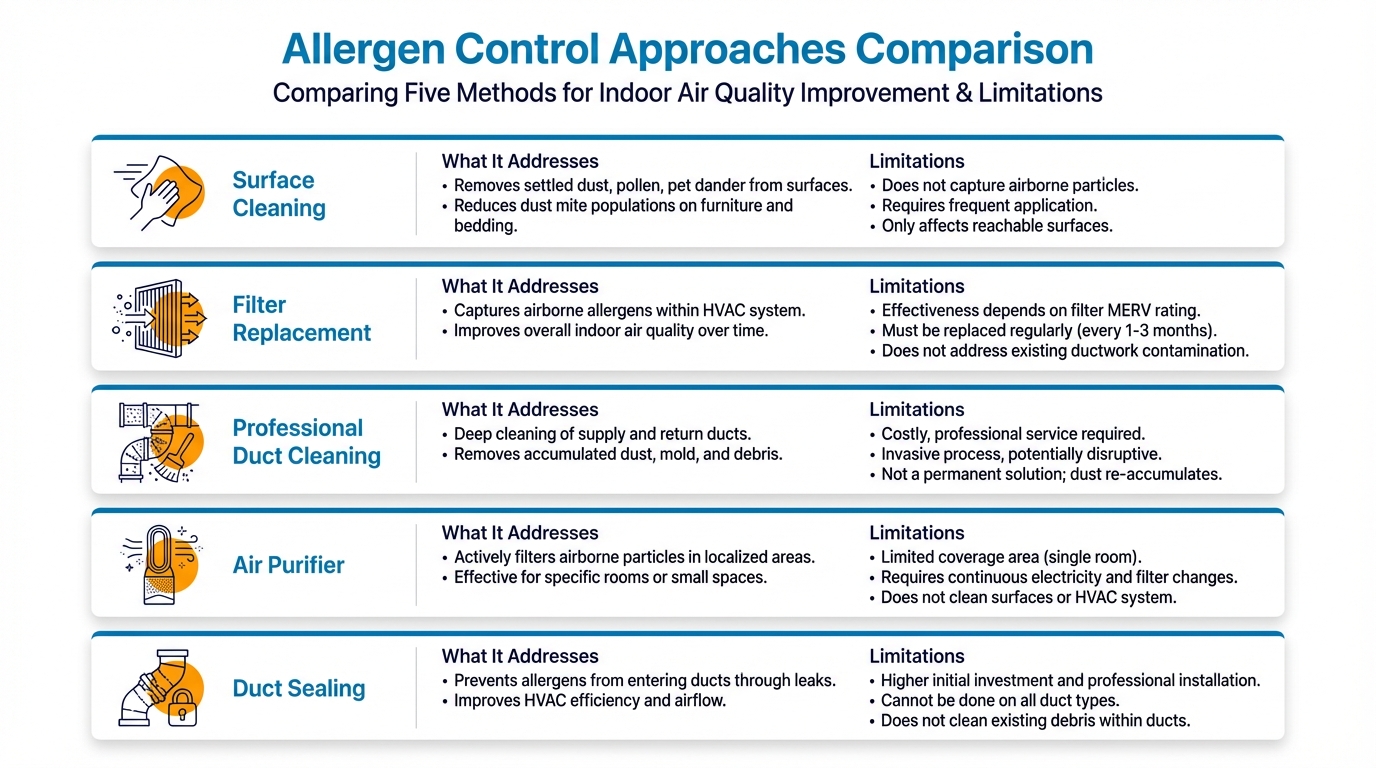
| Approach | What It Addresses | Limitations |
|---|---|---|
| Dusting and vacuuming surfaces | Settled dust on furniture, floors, shelves | Does not reach particles inside ductwork or trapped in upholstery fibers |
| Replacing HVAC filter regularly | Captures airborne particles as air circulates through the system | Cannot remove buildup already present inside ducts or on coils |
| Professional air duct cleaning | Accumulated dust, debris, dander, and pollen inside duct runs and plenums | Does not address ongoing sources like pets, open doors, or humidity without complementary steps |
| Portable air purifier in a single room | Suspended particles in the immediate area | Limited coverage; does not affect settled dust or particles in other rooms |
| Duct sealing and insulation improvement | Prevents unconditioned attic or crawlspace air from entering the system | Does not clean existing buildup; works best as a preventive or complementary measure |
The takeaway is that no single action solves the problem completely. Effective allergen dust control in a Dallas home combines surface habits, filtration upgrades, and professional system maintenance working together.
How Often Should Air Ducts Be Cleaned in Dallas?
There is no single number that applies to every home. Conditions in Dallas — extended cooling seasons, outdoor pollen loads, and frequent temperature swings — mean HVAC systems run more hours per year than in milder climates, which can accelerate buildup. Rather than following a rigid schedule, it is more useful to consider the factors that shorten the interval between cleanings: multiple pets shedding dander and fur, recent home renovation or construction nearby, a history of moisture intrusion or musty odors, visible dust accumulation around vents, and noticeable worsening of allergy symptoms when the system runs.
A practical approach for most Dallas homeowners is to have the ductwork inspected every few years and cleaned based on actual conditions rather than an arbitrary calendar date. Clean Air Dallas Pro provides thorough inspections that assess the real state of the system, so homeowners can make informed decisions rather than guessing. A video inspection of your ductwork can reveal exactly what has accumulated inside and whether cleaning is warranted.
Can Dirty Air Ducts Make Allergies Worse?
Yes, but with an important caveat: the degree of impact varies from home to home. When ducts and return-air pathways are loaded with dust, dander, pollen, or even traces of mold, those particles can be pushed back into living spaces each time the system cycles. For someone who is sensitive to these triggers, the effect can be noticeable — stuffy mornings, itchy eyes, or congestion that improves when you leave the house and returns when you come home.
It is worth emphasizing that not every allergy issue originates in the ductwork. Bedding, carpets, upholstered furniture, and humidity levels all play significant roles. However, ignoring dirty ducts means you may be addressing surface sources while a hidden reservoir keeps reintroducing particles into the air.
What Is the Best Air Filter for Allergy Control at Home?
Choosing a filter involves balancing particle capture efficiency against your HVAC system’s ability to maintain proper airflow. The EPA recommends upgrading to a MERV-13 rated filter, or the highest-rated filter compatible with your system, for improved removal of smaller particles like pollen, mold spores, and fine dust.
How Filter Choice Affects Dust and Airflow
A higher MERV rating means tighter filtration, which captures more allergen particles before they circulate through your rooms. However, if your HVAC system was not designed for a dense filter, it can restrict airflow, cause the blower motor to work harder, and actually reduce system performance. Checking your system’s specifications or asking a professional which rating your unit can handle is an important step before upgrading.
When to Replace Filters More Often
Standard guidance suggests changing filters every 60 to 90 days, but Dallas homes with pets, high outdoor pollen exposure, or ongoing renovation dust may need changes every 30 to 45 days. During peak cedar and ragweed seasons, pollen loads increase significantly, and a saturated filter quickly becomes part of the problem rather than the solution. Clean Air Dallas Pro can advise on filter selection and replacement that matches your specific system and household conditions, helping you get the best results without risking airflow problems.
Set a recurring reminder on your phone to check your HVAC filter on the first of each month. During peak pollen season in Dallas (typically March through May and September through November), inspect the filter every two to three weeks and replace it as soon as it appears visibly dirty or clogged.
Three Mistakes Dallas Homeowners Make When Trying to Reduce Allergens
Even well-intentioned efforts can fall short if common pitfalls go unrecognized. Here are three of the most frequent missteps.
Relying only on surface cleaning. Wiping down counters and vacuuming floors is essential, but if the ductwork is pushing out particles every time the system runs, surfaces get re-coated quickly. The cleaning effort never catches up to the recirculation cycle.
Opening windows during mild weather without checking pollen counts. Dallas enjoys stretches of comfortable weather in spring and fall, but those are also peak pollen seasons. The American Academy of Allergy, Asthma and Immunology recommends keeping windows closed during high-pollen periods and relying on air conditioning with clean filters to circulate air instead.
Ignoring humidity. Dallas humidity can climb quickly, and indoor moisture above 50 percent creates ideal conditions for dust mites and mold growth. Without monitoring and controlling humidity — using dehumidifiers, running bathroom exhaust fans, and fixing leaks promptly — other allergen-reduction steps lose effectiveness.
How Do I Keep Pollen Out of My House in Dallas?
Pollen management in Dallas requires a combination of behavioral habits and system-level defenses. Because the CDC notes that pollen types and seasons vary by region, Dallas homeowners face extended exposure windows from early spring through late fall.
Practical daily actions that make a measurable difference include removing shoes at the door to avoid tracking pollen inside, showering and changing clothes after extended time outdoors, wiping down pets before they settle on furniture, keeping entry areas clean with damp mopping rather than dry sweeping, and running the HVAC system on fan mode with a clean filter to continuously circulate and capture airborne particles even when heating or cooling is not needed.
These habits are simple individually, but their combined effect significantly reduces the volume of pollen that settles into carpets, bedding, and ductwork over time.
Can Pets Make Indoor Allergens Worse?
Pets are a major source of indoor allergens, but that does not mean you have to choose between your animals and cleaner air. Pet dander — tiny flakes of skin — along with saliva and fur, settles on every surface and gets drawn into the HVAC system through return vents. In homes with multiple pets or breeds that shed heavily, the accumulation can be substantial.
Practical steps include brushing pets regularly outdoors, washing pet bedding weekly in hot water, vacuuming with a HEPA-equipped vacuum, and cleaning the area around return vents where pet hair tends to collect. Increasing filter replacement frequency is also important. Additionally, comprehensive home maintenance like dryer vent cleaning reduces dust and lint accumulation in the laundry area — a space that often collects pet hair and contributes to overall household particulate levels.
Have questions about allergen control for your Dallas home? Our team is here to help with honest answers and professional solutions.
Do Air Purifiers Help with Dust and Allergens?
Portable air purifiers with HEPA filtration can help capture suspended particles in the room where they operate, making them useful for bedrooms and home offices where you spend extended time. However, they have meaningful limitations. A portable unit does not affect particles that have already settled on surfaces, and it does not address buildup inside ductwork. The EPA’s guide to air cleaners explains that HVAC-based filtration treats air throughout the entire home, while portable units provide targeted room-level support.
For the best results, consider air purifiers as one layer in a broader strategy rather than a standalone solution. They work most effectively when combined with proper HVAC filtration, regular duct maintenance, and consistent surface cleaning habits. For whole-home solutions, a UV light air purifier installation can help neutralize biological contaminants as air passes through the HVAC system.
What Should Homeowners Prioritize First to Reduce Allergens?
When you want to see results quickly, focus on the points that reintroduce particles into the air most aggressively. Start with the HVAC filter — if it is clogged or low-rated, every system cycle pushes poorly filtered air through every room. Next, address bedding: wash sheets, pillowcases, and mattress covers in hot water weekly. Then move to floors, especially in bedrooms and high-traffic areas, using damp mopping or a HEPA vacuum rather than dry sweeping that simply redistributes dust.
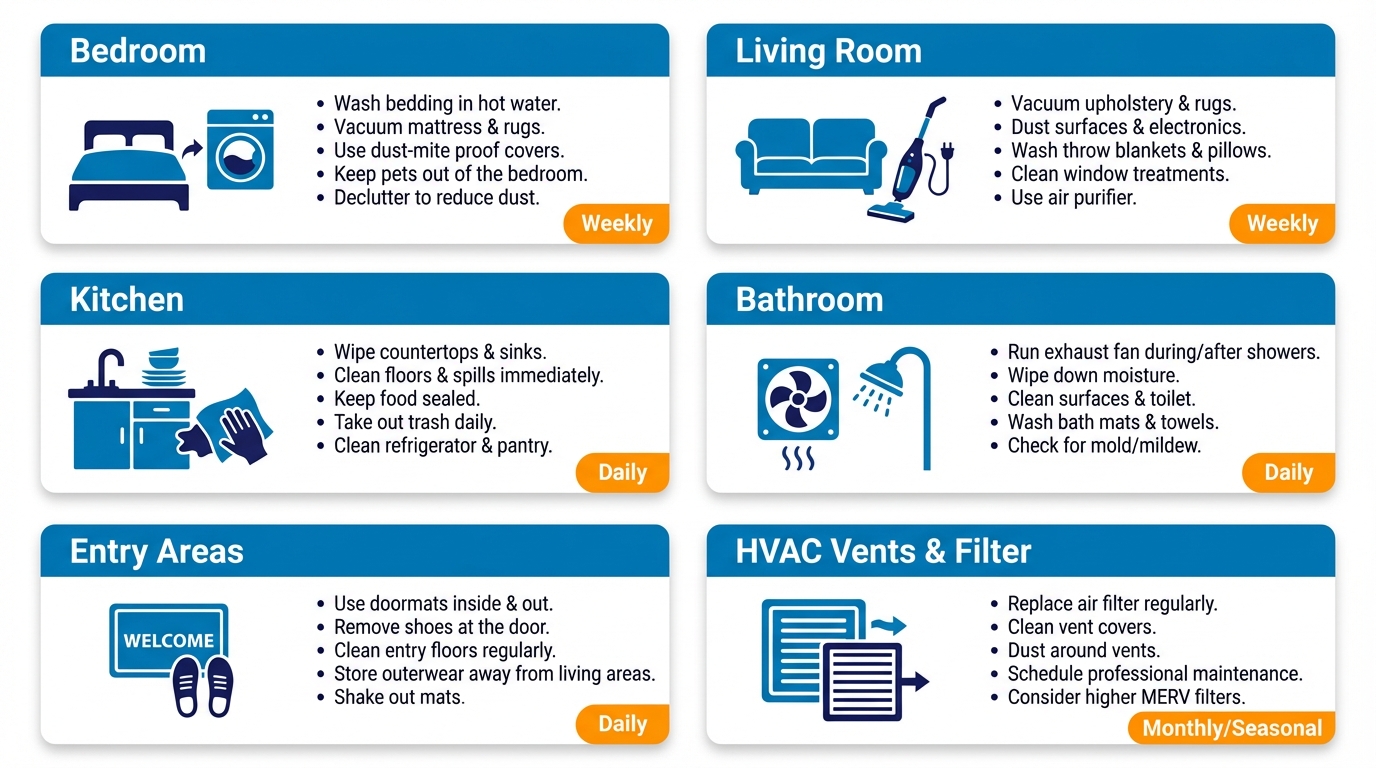
A Simple Room-by-Room Allergen Control Checklist
| Room | Priority Actions | Frequency |
|---|---|---|
| Bedroom | Wash bedding in hot water, encase pillows and mattress, vacuum under bed | Weekly |
| Living room | Vacuum upholstery, damp-mop hard floors, clean around supply and return vents | Weekly |
| Kitchen | Wipe surfaces, manage moisture from cooking, clean range hood filter | Daily to weekly |
| Bathroom | Run exhaust fan during and after showers, check for mold around tile and fixtures | Daily |
| Entry areas | Remove shoes, place washable mats, damp-mop regularly | Daily |
| HVAC vents and filter | Inspect filter, wipe register covers, check for visible dust buildup | Monthly check, replace filter every 30-90 days |
When wiping down supply and return register covers, use a damp microfiber cloth rather than a dry duster. Dry dusting tends to launch particles back into the air, while a damp cloth traps them for removal.
When Should a Homeowner Suspect the Air Ducts Are Part of the Problem?
Not every dusty home needs duct cleaning, and not every allergy flare-up points to the ductwork. However, certain patterns are worth paying attention to. If dust accumulates noticeably faster around supply registers than on other surfaces, if there is a musty or stale odor that appears only when the system runs, or if allergy symptoms consistently improve when you leave the house and worsen when you return and the HVAC is operating, the ducts may be contributing.
Other circumstances that increase the likelihood include recent renovations without duct protection, a home that has had water damage or plumbing leaks near ductwork, the presence of multiple pets over several years, or simply many years since the last professional inspection. In these situations, a video inspection of the duct interior can provide clear evidence of whether cleaning, repair, or sealing is warranted. Clean Air Dallas Pro offers detailed inspections that give homeowners a realistic picture of what is happening inside the system before any work is recommended.
Advanced Techniques: Duct Sealing, HEPA Filtration, and Insulation
Beyond cleaning, there are longer-term improvements that address the root causes of allergen infiltration. Duct sealing closes gaps and joints where unconditioned attic or crawlspace air — carrying dust, insulation fibers, and moisture — can enter the system and mix with your indoor air. This is especially relevant in older Dallas homes where ductwork may have loosened over decades of thermal expansion and contraction.
For households with severe allergy or asthma concerns, whole-house HEPA filtration or bypass HEPA systems provide hospital-grade particle capture. These systems are more involved than a simple filter swap, but they can make a significant difference for sensitive individuals. Improving attic insulation is another complementary step: better insulation reduces the temperature differential that drives air leakage through duct gaps and ceiling penetrations, keeping outdoor allergens from seeping into the living space. Regular air duct maintenance ensures these improvements continue performing as intended over time.
How Can Dallas Homeowners Build an Allergen-Reduction Plan That Actually Works?
An effective plan is not about doing one big thing — it is about layering consistent habits with periodic professional support. Daily actions like removing shoes, managing pet exposure, and running the HVAC fan with a quality filter create the baseline. Weekly tasks like hot-water bedding washes and targeted vacuuming reduce the allergen reservoirs that feed recirculation. Seasonally, checking humidity levels, inspecting filters more frequently during peak pollen months, and keeping windows closed during high-count days add another layer of protection.
Professional support fills the gaps that household habits cannot reach. Periodic duct inspection and cleaning, filter selection guidance, airflow testing and balancing, and duct sealing address the system-level factors that no amount of surface cleaning can resolve. For homes where odors persist even after cleaning, air duct odor removal and duct sanitizing services can address biological contaminants that contribute to both smell and allergen load. Clean Air Dallas Pro works with Dallas homeowners to assess actual conditions rather than applying a one-size-fits-all approach, which means recommendations are based on what your specific home and system need.
What Our Customers Say
Find Us
Breathe easier at home. Schedule your air duct inspection or cleaning service in Dallas today.
Frequently Asked Questions
It can help reduce exposure to accumulated allergens like dust, pollen, and pet dander when there is significant buildup inside the duct system. It works best as part of a broader strategy that includes filtration, humidity control, and regular cleaning rather than as a standalone solution.
Persistent dust usually results from particles recirculating through the HVAC system, inadequate filtration, and allergen reservoirs in carpets, bedding, and upholstery that release particles continuously. Addressing the ductwork and filter in addition to surface cleaning typically produces better results.
There is no universal schedule. Factors that shorten the interval include multiple pets, recent renovation, moisture history, visible dust around vents, and worsening indoor allergy symptoms. Having the system inspected periodically and cleaning based on actual conditions is the most practical approach.
Yes. Pollen enters on clothing, shoes, pets, and through small gaps around doors and windows. It can also be drawn into the HVAC system through outdoor air intake. Regular filter changes and cleaning entry areas help reduce the amount that accumulates indoors.
Portable HEPA air purifiers can reduce airborne particles in the specific room where they operate, making them useful for bedrooms. They do not replace HVAC filtration or duct maintenance and work best as an additional layer within a comprehensive plan.
Watch for rapid dust buildup around supply registers, musty or stale smells when the system runs, allergy symptoms that worsen indoors, and visible dust or debris inside register openings. Any of these patterns may indicate that a professional inspection is a worthwhile next step.
Upgrading to a MERV-13 filter can capture significantly more fine particles like pollen and pet dander. The improvement is often noticeable within days, especially in homes that were previously using low-rated filters. Always confirm your system can handle the higher-rated filter to avoid airflow restrictions.