
Complete Guide to Mold in Air Ducts Prevention Remediation Dallas TX
If you have noticed a persistent musty smell when your HVAC system kicks on, or dark discoloration has appeared around your supply vents, your Dallas property may be dealing with mold growth inside the ductwork. North Texas sits within a humid subtropical climate zone where warm Gulf moisture regularly pushes through the metroplex, creating ideal conditions for mold spores to settle and multiply on damp surfaces inside ventilation systems. Understanding how mold develops in air ducts, when professional remediation is truly needed, and what preventive measures actually work can save Dallas homeowners and commercial property managers both money and frustration.
Estimated reading time: 14 minutes
Key Takeaways
- Musty odors when the HVAC runs and dark spots around vents are early signs of mold growth inside Dallas ductwork.
- Moisture is the primary driver of duct mold — clogged condensate drains, poor insulation, and unsealed duct joints are the most common culprits in North Texas homes.
- Standard duct cleaning, mold removal, and mold remediation are three distinct service levels — knowing the difference prevents wasted money and recurring problems.
- Texas TDLR licensing separates mold assessment from remediation, providing important consumer protection for Dallas property owners.
- Prevention through humidity control, drain line maintenance, duct inspections, and regular filter replacement is far less costly than repeated remediation.
- Professional post-remediation verification ensures the moisture source is resolved and the system is distributing clean air effectively.
- How Do You Know if There Is Mold Inside Your Air Ducts?
- A Scenario Many Dallas Homeowners Recognize
- Why Is Mold in Ventilation Systems a Health Concern?
- What Causes Mold to Grow in HVAC Ductwork?
- Comparing Duct Cleaning, Mold Removal, and Mold Remediation
- Five Common Mistakes Homeowners Make When Dealing With Duct Mold
- How Does a Professional Remediation Process Actually Work?
- What Does Texas Law Require for Mold Remediation Work?
- Practical Strategies to Prevent Mold in Your Dallas HVAC System
- When Should Dallas Businesses Call for Professional Help?
- Key Benchmarks: How to Evaluate Whether Remediation Was Successful
- Can Mold Come Back After Professional Remediation?
- Frequently Asked Questions About Mold in Air Ducts
- Ready to Address Mold Concerns in Your Dallas Ductwork?
How Do You Know if There Is Mold Inside Your Air Ducts?
The most common early indicator is a damp, earthy odor that becomes stronger when the HVAC system is running. Because air moves through contaminated ductwork before entering living spaces, the smell tends to spread throughout the home or building rather than staying in one room. Visual clues include dark spots or discoloration around register covers and on visible sections of ductwork near the air handler. Some homeowners also notice that allergy-type symptoms such as sneezing, eye irritation, or nasal congestion seem to worsen indoors and improve when they leave the property.
However, not every dark patch inside a vent is mold. Accumulated dust, soot from cooking or candles, and general debris can look strikingly similar. According to EPA guidance on duct cleaning, visible mold growth on hard-surface ducts or HVAC components is one of the primary reasons professional inspection is warranted. A qualified professional can determine whether the substance is actually mold, assess how far it has spread, and identify the moisture condition that allowed it to develop in the first place.
A Scenario Many Dallas Homeowners Recognize
Imagine running the air conditioner from May through October in a Dallas home. The system cycles constantly during peak heat, condensation forms on the evaporator coil and nearby surfaces, and the drain line slowly develops a partial clog. Over weeks, moisture accumulates in and around the air handler, creating a damp film on interior duct walls near the unit. By the time you notice a musty smell in the hallway, mold has had weeks of undisturbed growth. This scenario is extremely common in the Dallas–Fort Worth area because of the extended cooling season and the sheer volume of condensation that HVAC systems produce locally.
Why Is Mold in Ventilation Systems a Health Concern?
Mold spores are naturally present in outdoor air and in small quantities indoors. The problem occurs when an active colony inside ductwork continuously releases spores into the air you breathe. As the CDC notes regarding Aspergillus exposure, people with weakened immune systems, chronic lung conditions, or severe allergies face a higher risk of respiratory complications from elevated indoor mold concentrations. Even for generally healthy individuals, prolonged exposure to mold-contaminated air may cause nasal congestion, throat irritation, coughing, and eye discomfort.
Because HVAC ductwork distributes conditioned air to every room in the home or building, a single point of active mold growth can affect indoor air quality throughout the entire property. That is why addressing mold in air ducts promptly matters, especially for families with young children, elderly residents, or anyone managing respiratory sensitivities. Professional air duct cleaning combined with proper remediation can significantly reduce the concentration of airborne contaminants circulating through a Dallas property.
Concerned about musty odors or mold in your Dallas ductwork? Get a professional evaluation today.
What Causes Mold to Grow in HVAC Ductwork?
Mold needs three things to establish itself: moisture, a food source such as dust or organic debris, and a surface. Inside ductwork, all three are readily available when conditions go unchecked. The primary driver is always moisture, and in Dallas HVAC systems several common sources create that moisture.
Condensation and Drainage Failures
Every air conditioning cycle produces condensation on the evaporator coil. That moisture is supposed to drip into a drain pan and exit through a drain line. When the drain line partially clogs, the pan overflows, or connections develop small leaks, water sits in or near the ductwork. Even minor, persistent dampness is enough for mold colonies to establish themselves within a few days.
Inadequate Insulation and Outdoor Humidity
Ductwork running through unconditioned spaces like attics, crawl spaces, or between walls can develop external condensation when warm, humid outdoor air contacts cooler duct surfaces. In Dallas, where summer dew points frequently climb above 70 °F according to the National Weather Service Dallas/Fort Worth climate summary, this condensation risk is especially high from late spring through early fall. Poorly insulated or unsealed duct joints amplify the problem by allowing humid air to reach cold metal or flex-duct surfaces.
Comparing Duct Cleaning, Mold Removal, and Mold Remediation
One of the most misunderstood areas in indoor air quality service is the distinction between these three terms. Dallas homeowners often search for air duct mold removal only to discover that what they actually need is a more comprehensive approach. The following table clarifies how each service level differs.
| Service Level | What It Addresses | When It Applies |
|---|---|---|
| Standard Duct Cleaning | Dust, debris, pet dander, and general buildup on interior duct surfaces | Routine maintenance or when airflow has decreased and no active mold is present |
| Mold Removal (Surface Cleaning) | Visible mold on hard, non-porous duct surfaces such as sheet metal | Small, isolated areas of surface mold where the moisture source has already been fixed |
| Mold Remediation | Active mold growth including containment, source identification, removal of contaminated porous materials, cleaning, antimicrobial treatment, and prevention | Widespread or recurring mold, mold on porous insulation or flex duct material, or when the moisture source has not yet been resolved |
According to EPA standards on duct material contamination, wet or moldy fiberglass duct insulation generally cannot be effectively cleaned and should be replaced. This is a critical distinction that separates surface-level duct cleaning from a genuine remediation project. If a service provider offers only a quick wipe-down without evaluating moisture conditions or porous materials, the mold is likely to return.
Five Common Mistakes Homeowners Make When Dealing With Duct Mold
Mistake 1 — Assuming bleach solves the problem. Household bleach can kill surface mold on non-porous materials, but it does not penetrate porous duct insulation, and it does nothing to address the moisture source. In many cases, surface mold returns within weeks.
Mistake 2 — Ignoring the drain line. A partially clogged condensate drain is one of the most common and most overlooked moisture sources in Dallas HVAC systems. Regular drain line maintenance can prevent a significant percentage of mold issues.
Mistake 3 — Hiring based on price alone. Extremely low-cost duct cleaning offers sometimes skip the inspection step entirely, meaning active mold or moisture problems go undetected. A proper evaluation before any work begins is essential.
Mistake 4 — Delaying action after noticing a musty smell. The EPA recommends drying wet materials within 24 to 48 hours to prevent mold growth. The longer moisture sits inside ductwork, the more extensive the remediation effort becomes.
Mistake 5 — Skipping post-remediation verification. After treatment, confirming that airflow is restored, moisture readings are normal, and no visible growth remains is an important final step. Without verification, hidden issues may persist.
How Does a Professional Remediation Process Actually Work?
A thorough mold remediation project in ductwork follows a logical sequence designed to resolve the current contamination and prevent future recurrence. While exact procedures vary based on the scope of the problem, the general framework includes the following steps.
Inspection and assessment. A trained professional examines the HVAC system, ductwork, and surrounding areas to identify visible mold, moisture sources, and any damage to duct materials. In some cases, a separate mold assessment may be recommended to confirm the type and extent of contamination.
Containment. Affected sections of ductwork are isolated to prevent spores from spreading to clean areas during the cleaning process. This may involve sealing registers, using negative-air machines, or physically separating duct sections.
Removal and cleaning. Hard, non-porous duct surfaces are cleaned using appropriate methods, often including HEPA-filtered vacuuming and antimicrobial treatment. Porous materials such as fiberglass insulation or certain types of flex duct that have become contaminated are typically removed and replaced.
Moisture source correction. Whether it is a drain line issue, a duct seal failure, or an insulation gap, the underlying cause of the moisture is repaired. Without this step, mold growth is likely to recur regardless of how thorough the cleaning was.
Verification and documentation. Airflow testing, visual inspection, and in some cases post-remediation clearance testing confirm that the work was effective and that the system is operating cleanly.
Don’t let mold compromise your indoor air quality. Clean Air Dallas Pro provides thorough duct inspection and remediation services across Dallas.
What Does Texas Law Require for Mold Remediation Work?
Texas takes mold remediation seriously from a regulatory standpoint. Under Occupations Code Chapter 1958, the Texas Department of Licensing and Regulation (TDLR) oversees licensing for mold assessors and mold remediators as separate categories. This means that in many situations, the company performing the assessment cannot also perform the remediation work, ensuring an independent evaluation. The TDLR mold program rules outline minimum standards for notification, work practices, and post-remediation requirements.
For Dallas homeowners, this regulatory framework provides an important layer of consumer protection. When hiring a company for air duct mold removal in Dallas, TX, verifying that the provider holds the appropriate TDLR license for the scope of work is a practical first step. Clean Air Dallas Pro operates in alignment with applicable local standards, and the team can help property owners understand what level of service their situation requires before any work begins.
Practical Strategies to Prevent Mold in Your Dallas HVAC System
Prevention is almost always less expensive and less disruptive than remediation. Because moisture is the root cause of mold growth, controlling moisture inside and around the HVAC system is the single most effective strategy. The following measures are particularly relevant for properties in the Dallas area.

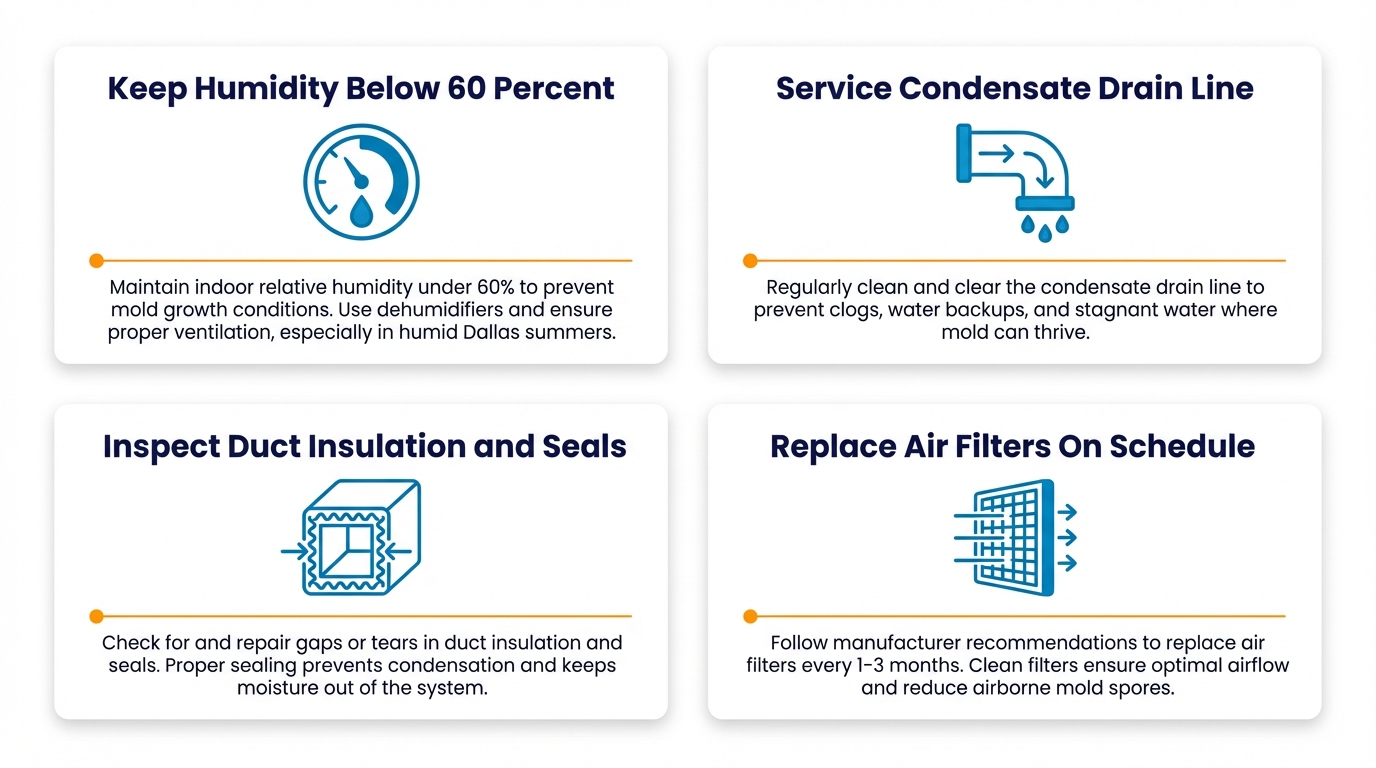
Keep indoor humidity below 60 percent. The EPA recommends maintaining relative humidity between 30 and 60 percent to discourage mold growth. In Dallas, a properly sized and functioning air conditioning system handles much of this dehumidification work automatically, but supplemental dehumidification may be needed in especially humid conditions or in commercial spaces with high occupancy.
Service the condensate drain line regularly. Flushing the drain line at least twice per year, ideally before the cooling season begins and midway through summer, helps prevent the slow clogs that create standing water near the air handler.
Inspect ductwork insulation and seals. Gaps in duct joints or deteriorated insulation allow warm, moist air to contact cool duct surfaces. Having ductwork inspected periodically, especially in attics and crawl spaces, can catch problems before condensation leads to mold.
Replace air filters on schedule. Clogged filters reduce airflow, which can cause the evaporator coil to run colder than designed and produce excess condensation. Maintaining proper filter replacement intervals supports balanced airflow and normal moisture management. Clean Air Dallas Pro provides air filter replacement and airflow testing services that help Dallas homeowners stay ahead of these issues rather than reacting after mold appears.
When Should Dallas Businesses Call for Professional Help?
Commercial properties face a different set of pressures when mold develops in HVAC ductwork. Employees may file indoor air quality complaints, tenants may demand remediation before renewing leases, and building managers face potential liability if contamination is ignored. In office buildings, retail spaces, and healthcare facilities, the stakes are especially high because these environments serve large numbers of people daily.
Recurring mold issues in commercial ductwork often point to systemic problems: oversized or undersized HVAC equipment, roof leaks that introduce moisture into plenum spaces, or deferred maintenance on aging air handling units. A one-time cleaning may provide temporary relief, but unless the underlying building-performance issues are addressed, the cycle of contamination will continue. Clean Air Dallas Pro works with commercial clients in Dallas to evaluate the full picture, from ductwork condition to airflow balance, so that remediation efforts deliver lasting results rather than short-term fixes.
| Business Need | How Professional Service Helps |
|---|---|
| Persistent musty odor complaints from staff or tenants | Thorough inspection identifies hidden mold sources inside ductwork and air handling units |
| Regulatory or lease compliance requirements | Documented assessment and remediation process provides a clear record of action taken |
| Recurring mold after previous cleaning | Root-cause analysis of moisture sources prevents repeated contamination cycles |
| Aging or damaged ductwork in commercial spaces | Duct repair, sealing, or replacement addresses structural conditions that trap moisture |
| Desire for better indoor air quality and HVAC performance | Comprehensive cleaning plus airflow testing ensures the system runs efficiently and distributes cleaner air |
Key Benchmarks: How to Evaluate Whether Remediation Was Successful
After a mold remediation project, there are several measurable indicators that the work was effective. Understanding these benchmarks helps property owners hold service providers accountable and gives confidence that the investment produced real results.
No visible mold on treated surfaces. After cleaning and treatment, all accessible duct surfaces should be free of visible growth. Any areas where porous material was replaced should show clean, dry installation.
No musty odor when the system operates. If the smell returns within days or weeks, there may be an untreated section or an unresolved moisture source that needs further investigation.
Normal humidity readings near the air handler. Relative humidity around the indoor unit and in the immediate duct vicinity should align with the recommended range. Elevated readings suggest ongoing moisture that could restart the growth cycle.
Restored airflow at supply registers. Mold buildup and the remediation process itself can temporarily affect airflow. Post-service airflow testing confirms that the system is delivering conditioned air effectively to all zones. Clean Air Dallas Pro includes airflow verification as part of its remediation and duct service process, helping Dallas property owners confirm that the system is performing as expected after work is completed.
Can Mold Come Back After Professional Remediation?
Yes, it can, and being honest about that reality is important. Mold spores exist everywhere in the natural environment, and no remediation process eliminates them entirely from indoor air. The goal of remediation is not to create a sterile environment but to remove active colonies, clean contaminated materials, and eliminate the conditions that allowed growth in the first place. If the moisture source is genuinely corrected, the ductwork is properly sealed, and the HVAC system receives routine maintenance, the likelihood of recurrence drops significantly.
Dallas homeowners who invest in preventive measures after remediation, such as regular drain line maintenance, periodic duct inspections, and consistent filter replacement, are far less likely to face a repeat problem. Think of remediation as a reset and prevention as the ongoing commitment that protects that investment.
Protect your investment with professional duct cleaning and mold prevention services from Clean Air Dallas Pro.
Frequently Asked Questions About Mold in Air Ducts
No. Standard duct cleaning removes dust and debris from duct surfaces. Mold remediation is a more comprehensive process that includes identifying the moisture source, containing the affected area, removing contaminated materials, applying antimicrobial treatment, and implementing prevention measures. Cleaning alone is not sufficient when active mold growth or contaminated porous materials are present.
Not always. If visible mold is present and the moisture source is identifiable, many professionals proceed directly to remediation. However, when the extent of contamination is unclear or when documentation is needed for insurance or compliance purposes, a separate mold assessment can provide useful data. Texas TDLR rules distinguish between assessment and remediation as separate licensed functions.
The timeline depends on the size of the affected area, the type of ductwork involved, and whether significant repair or replacement is needed. A straightforward residential project may take one to two days, while a larger commercial remediation with duct replacement could extend longer. A professional inspection provides the most accurate estimate for your specific property.
Surface mold on a vent cover or register can sometimes be cleaned with household products. However, mold that has spread deeper into ductwork, onto insulation, or near the air handler typically requires professional equipment such as HEPA-filtered vacuums, containment barriers, and appropriate antimicrobial treatments. Attempting extensive DIY remediation risks spreading spores to unaffected areas of the home.
Cost varies based on several factors, including the size of the home or building, the number of duct runs affected, the type of duct material, whether insulation replacement is needed, and the scope of moisture repair required. Because no two situations are identical, a professional on-site evaluation is the most reliable way to receive an accurate estimate.
The Dallas–Fort Worth area experiences extended periods of high outdoor humidity combined with heavy air conditioning use. This creates substantial condensation within HVAC systems, especially when maintenance is deferred. Properties with ductwork in unconditioned attic spaces face additional risk because temperature differentials between the attic and the cooled air inside ducts promote condensation on exterior duct surfaces.
Ready to Address Mold Concerns in Your Dallas Ductwork?
If you have noticed a musty odor, visible discoloration around vents, or recurring allergy symptoms that seem to worsen indoors, the next step is a professional evaluation of your ductwork and HVAC system. Waiting allows moisture conditions to worsen and mold to spread further, making remediation more involved and more costly. Clean Air Dallas Pro provides thorough inspection, honest assessment, and dependable remediation and prevention services for residential and commercial properties throughout Dallas. Contact Clean Air Dallas Pro to schedule an inspection, ask about mold remediation options, or request a free estimate for your property.
What Our Dallas Customers Say
“I had the pleasure of hiring this exceptional firm to clean my air ducts, and I am really pleased with the outcomes. Their team’s expertise in air duct cleaning is unparalleled. My indoor air quality has improved significantly as a consequence of their painstaking efforts.”
— Laura S. Turner
“This company was my first choice while searching for ‘air duct cleaning near me’. They are experts at cleaning ducts. Their versatility and dependability are unparalleled.”
— Camille Pearce
“My expectations were surpassed by Clean Air Dallas Pro’s vent cleaning service. The crew completed the task with efficiency, and the procedure ran smoothly from beginning to end. My HVAC system’s efficiency and airflow started to alter right away.”
— Rickey Williams
Find Clean Air Dallas Pro
Clean Air Dallas Pro — 2710 Guillot St, Dallas, TX 75204 — (214) 935-5058 — [email protected]

Clean Air Dallas Pro Team
The Clean Air Dallas Pro Team serves residential and commercial properties throughout Dallas, TX with professional air duct cleaning, mold remediation, and indoor air quality services. With a commitment to honest assessments and thorough workmanship, our team helps Dallas homeowners and businesses breathe cleaner, healthier air. Contact us to learn how we can help improve your indoor environment.