
HVAC energy efficiency tips homeowner guide Dallas for lower utility bills
Dallas homeowners know the frustration of watching energy bills climb every summer while their HVAC system works overtime against relentless heat. The good news is that most high cooling costs are caused by a combination of small, fixable inefficiencies—from dirty filters and leaky ducts to poor insulation and thermostat habits. This comprehensive guide walks through the most practical steps you can take to reduce HVAC energy waste, improve indoor comfort, and get more value from the system you already own.
Estimated reading time: 14 minutes
Key Takeaways
- High Dallas cooling bills are usually caused by multiple small inefficiencies stacking up—not a single broken component.
- Duct sealing and attic insulation improvements often deliver more savings than replacing the HVAC system itself.
- Replacing air filters monthly during peak cooling season is one of the simplest and most impactful efficiency steps.
- Smart thermostats can save approximately 8 percent on heating and cooling bills when scheduling features are actively used.
- Addressing the building envelope (insulation, air sealing, duct integrity) before upgrading equipment maximizes every dollar spent.
- Professional air duct cleaning restores airflow and supports overall system efficiency in dusty, high-runtime Dallas conditions.
- Why Are HVAC Energy Bills So High in Dallas Homes?
- What Local Conditions Make Dallas Cooling Costs Worse?
- What Thermostat Setting Saves the Most Energy in a Dallas Summer?
- Does Changing the Air Filter Really Improve HVAC Efficiency?
- A Mistake Many Homeowners Make: Ignoring Ductwork
- How Duct Sealing Compares to Other Efficiency Actions
- Should You Replace Your HVAC System or Improve Insulation First?
- How Can Dallas Homeowners Make an Older System More Efficient?
- What Home Upgrades Reduce HVAC Workload the Most?
- Do Smart Thermostats Really Lower Cooling Costs?
- When Does Upgrading to a High-Efficiency System Make Sense?
- A Practical HVAC Efficiency Checklist for Dallas Homeowners
- Frequently Asked Questions
- Ready to Improve Comfort and Lower Energy Costs in Your Dallas Home?
Why Are HVAC Energy Bills So High in Dallas Homes?
High cooling bills in Dallas do not always mean something is broken. They often point to hidden efficiency losses that build up over time. The long cooling season—typically stretching from late April through October—means even a small daily inefficiency compounds into a much larger number on the monthly statement. Homes built before modern energy codes may have minimal attic insulation, single-pane windows, or ductwork routed through superheated attic spaces where temperatures can exceed 140°F on a summer afternoon.
Duct leaks alone can waste a significant portion of conditioned air before it ever reaches the rooms you are trying to cool. Add a clogged filter, a thermostat set lower than necessary, and an outdoor unit surrounded by debris, and the system is fighting inefficiency on multiple fronts. Understanding the cause behind a high bill is more useful than simply turning the thermostat up and hoping for the best.
What Local Conditions Make Dallas Cooling Costs Worse?
Several factors specific to the Dallas area make cooling costs harder to control. According to the National Weather Service, the Dallas/Fort Worth area experiences prolonged high-heat periods and elevated humidity that push residential cooling systems to their limits season after season. West-facing rooms absorb intense afternoon solar heat. Two-story homes frequently experience a large temperature gap between floors because hot air rises and attic heat radiates downward. Older neighborhoods often have original ductwork that was never sealed or insulated to current standards.
Because humidity levels stay elevated for much of the year, the air conditioner has to remove moisture as well as heat—doubling its workload. Homes with single-zone systems are especially vulnerable. Without zoning, the system treats the entire house as one space, which means the downstairs may overcool while the upstairs stays uncomfortably warm. Return airflow imbalances—where too few return vents serve the upper floor—make this worse. Recognizing these patterns helps homeowners target the right improvements instead of guessing.
Struggling with uneven cooling or rising energy bills in your Dallas home?
What Thermostat Setting Saves the Most Energy in a Dallas Summer?
The most energy-efficient thermostat setting is the highest temperature that still feels comfortable when you are home, combined with a higher setpoint when you are away. The U.S. Department of Energy recommends 78°F when you are home and awake, and higher when you are sleeping or away. The Public Utility Commission of Texas echoes this guidance for hot-weather months. Each degree you raise the thermostat above 78°F can reduce cooling costs, because the system runs less when the gap between indoor and outdoor temperatures is smaller.
A common mistake is setting the thermostat very low when returning home, hoping the house will cool faster. Air conditioners deliver cool air at the same rate regardless of the setpoint—a lower number just means the system runs longer. Consistent scheduling through a programmable or smart thermostat avoids this waste. ENERGY STAR certified smart thermostats can save approximately 8 percent on heating and cooling bills, which averages around $50 per year for a typical household. For Dallas homes with above-average cooling costs, the savings can be higher.
Overall home efficiency also includes keeping all ventilation pathways clear, which is why periodic dryer vent cleaning supports both safety and better airflow through the home.
Does Changing the Air Filter Really Improve HVAC Efficiency?
Yes—and it is one of the simplest improvements a homeowner can make. A dirty air filter restricts the airflow your system needs to operate properly. When the blower motor has to push air through a clogged filter, it draws more energy, runs longer, and delivers less cooling to each room. In severe cases, restricted airflow can cause the evaporator coil to freeze, leading to a system shutdown and a repair call.
The EPA recommends replacing or cleaning filters according to manufacturer guidelines, and in Dallas the practical recommendation is monthly replacement during peak cooling months because of high dust levels, pollen, and continuous system runtime. Filter fit also matters. If the filter does not sit snugly in its housing, unfiltered “bypass” air flows around it, reducing both filtration effectiveness and system protection. When choosing a higher-efficiency filter, make sure the HVAC system can handle the increased resistance—check the manufacturer’s specifications or ask a professional.
Clean Air Dallas Pro helps Dallas homeowners address these airflow fundamentals with localized maintenance that accounts for the area’s dust and humidity challenges. For many homes, foundational system cleanliness through professional air duct cleaning services is the first step toward meaningful efficiency improvement.
A Mistake Many Homeowners Make: Ignoring Ductwork
Ductwork is often out of sight, running through attics, crawl spaces, and interior walls. Because homeowners rarely see it, they rarely think about it. But the U.S. Department of Energy identifies duct leaks and poor duct insulation as major contributors to energy waste in residential cooling systems. In a Dallas home where ducts pass through an attic that may reach extreme temperatures, even small gaps or disconnected joints can result in substantial conditioned-air loss.
Leaky supply ducts push cooled air into unconditioned spaces instead of living areas. Leaky return ducts pull hot attic air into the system, forcing the air conditioner to work harder. Both problems increase runtime, raise utility costs, and make it difficult to keep the home comfortable. Duct sealing—using mastic sealant or metal-backed tape on joints and connections—is one of the highest-impact improvements available. When combined with proper duct insulation, it helps ensure that the air your system cools actually reaches the rooms where you need it.
How Duct Sealing Compares to Other Efficiency Actions
| Efficiency Action | Typical Impact on Cooling Costs | Effort Level |
|---|---|---|
| Replacing air filters monthly | Prevents gradual efficiency loss | Low — homeowner task |
| Thermostat scheduling or smart thermostat | Can reduce cooling costs by up to 8 percent | Low to moderate |
| Duct sealing in unconditioned spaces | Reduces conditioned-air loss significantly | Moderate — professional recommended |
| Adding attic insulation | Lowers heat transfer into living space | Moderate to high — professional recommended |
| Full HVAC system replacement | Depends on current system age and condition | High — professional installation required |
Notice that the two highest-impact items—duct sealing and insulation—address the building envelope rather than the equipment itself. Many homeowners jump to the idea of replacing the air conditioner when the real issue is that their home is losing conditioned air before it can do its job.
Should You Replace Your HVAC System or Improve Insulation First?
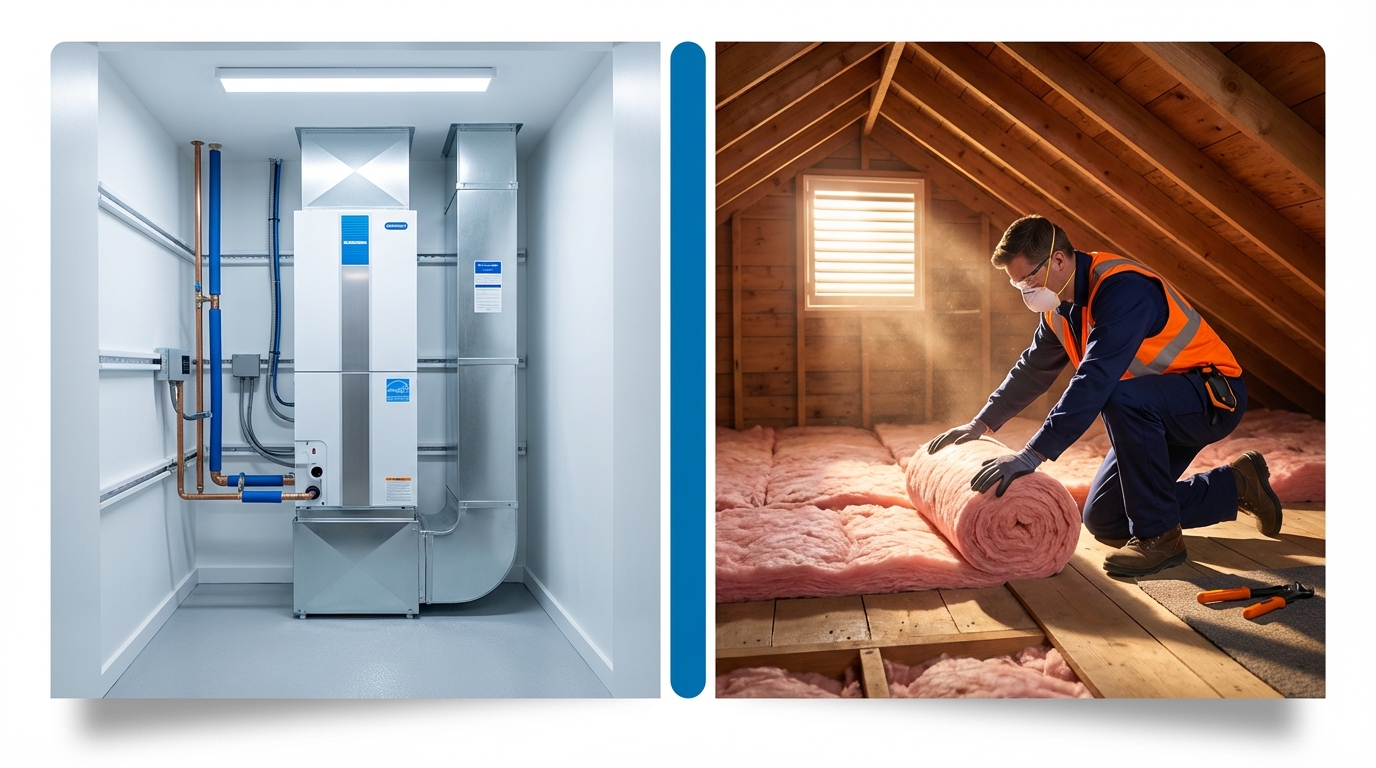
This is one of the most important questions Dallas homeowners can ask, and it is one that most generic efficiency guides skip over. The answer depends on where the biggest losses are occurring. If the home has inadequate attic insulation, visible duct leaks, air gaps around penetrations, or significant solar heat gain, those building-envelope issues are often responsible for a larger share of the high bill than the equipment itself.
Improving insulation and sealing air leaks reduces the total cooling load. That means whatever system is in place—old or new—runs less and works more effectively. In some cases, envelope improvements reduce the cooling load enough that the existing system performs adequately, delaying the need for a costly replacement. When the time does come to replace equipment, a smaller, properly sized system may be all the home needs, which also lowers the upfront purchase cost.
On the other hand, if the HVAC system is more than 15 years old, requires frequent repairs, struggles to manage humidity, or uses an outdated refrigerant, replacement may be the more practical first step. The best approach is to evaluate both the home and the equipment before committing to either path. ENERGY STAR recommends that homeowners conduct basic DIY checks of their thermal envelope before making a hardware decision.
Not sure whether to upgrade your system or fix the ducts and insulation first? We can help you find out.
How Can Dallas Homeowners Make an Older System More Efficient?
Not every homeowner is ready for a full system replacement, and that is perfectly reasonable. There are several ways to reduce energy waste from an older HVAC system while it is still operational. Start with the basics: clean or replace the air filter monthly, make sure all supply and return vents are open and unobstructed, keep the outdoor condenser unit clear of vegetation and debris, and verify that the thermostat schedule matches your actual daily routine.
Beyond those steps, consider professional maintenance that includes coil cleaning, refrigerant charge verification, electrical connection inspection, condensate drain clearing, and airflow testing. A system that has not been serviced in several years may be running well below its original efficiency simply because of accumulated dirt and minor component wear. Clean Air Dallas Pro provides thorough, locally focused HVAC maintenance and airflow assessment that addresses the specific demands of Dallas homes—high dust, extended runtime, and the strain of sustained summer heat.
What Home Upgrades Reduce HVAC Workload the Most?
The upgrades that deliver the greatest return are those that reduce how much heat enters the home in the first place. In Dallas, attic insulation is near the top of the list. A poorly insulated attic allows radiant heat to transfer directly into the living space below, forcing the air conditioner to compensate continuously. Adding or upgrading insulation creates a thermal barrier that keeps more heat out and more cooled air in.
Air sealing—closing gaps around plumbing penetrations, electrical boxes, recessed lights, and attic access points—works alongside insulation to create what ENERGY STAR calls a “Complete Thermal Enclosure System.” Solar screens on west- and south-facing windows reduce heat gain without blocking all daylight. Weather-stripping around doors and windows closes drafts that let conditioned air escape. For long-term savings, combining these behavioral changes and envelope improvements with professional attic insulation services provides among the highest returns for Dallas residents.
| Homeowner Need | How Clean Air Dallas Pro Can Help |
|---|---|
| Dirty or blocked ductwork reducing airflow | Professional air duct cleaning removes buildup and restores airflow |
| Suspected duct leaks causing uneven cooling | Duct inspection and sealing to reduce conditioned-air loss |
| Attic heat driving up cooling costs | Attic insulation evaluation and replacement for better thermal performance |
| Indoor air quality concerns alongside efficiency goals | Air quality testing and sanitizing to address both comfort and cleanliness |
| Dryer taking too long or running hot | Dryer vent cleaning to improve safety and reduce energy waste |
Do Smart Thermostats Really Lower Cooling Costs?

Smart thermostats can lower cooling costs, but the savings depend on how they are used. The device itself does not save energy—the scheduling, occupancy sensing, and remote adjustments it enables are what reduce unnecessary runtime. A homeowner who already manages the thermostat carefully may see modest improvement. A homeowner who currently leaves the system running at a constant low temperature while away from home may see a more noticeable difference.
ENERGY STAR data shows average savings of about 8 percent on heating and cooling bills for certified smart thermostats. In a Dallas home where cooling accounts for a large share of annual energy costs, that percentage translates into meaningful dollar savings over a full summer. The key is to actually use the scheduling and automation features rather than overriding them manually, which many homeowners end up doing.
When Does Upgrading to a High-Efficiency System Make Sense?
There comes a point where maintenance and envelope improvements are no longer enough, and a system upgrade becomes the practical choice. Signs include frequent breakdowns, rising repair costs, inconsistent humidity control, and a noticeable decline in cooling performance despite regular maintenance. Age is a factor too—systems beyond 15 years are typically operating well below modern efficiency standards.
Current federal efficiency thresholds for ENERGY STAR certification require central air conditioners to meet specific SEER2 and EER2 ratings. These ratings reflect real-world performance more accurately than older metrics. Modern systems also manage dehumidification more effectively than older models, which is a significant comfort advantage in the Dallas climate where humidity compounds the sensation of heat. Before committing to a replacement, homeowners should evaluate duct condition, insulation quality, and overall home tightness. A high-efficiency system installed in a leaky home will still underperform.
A Practical HVAC Efficiency Checklist for Dallas Homeowners
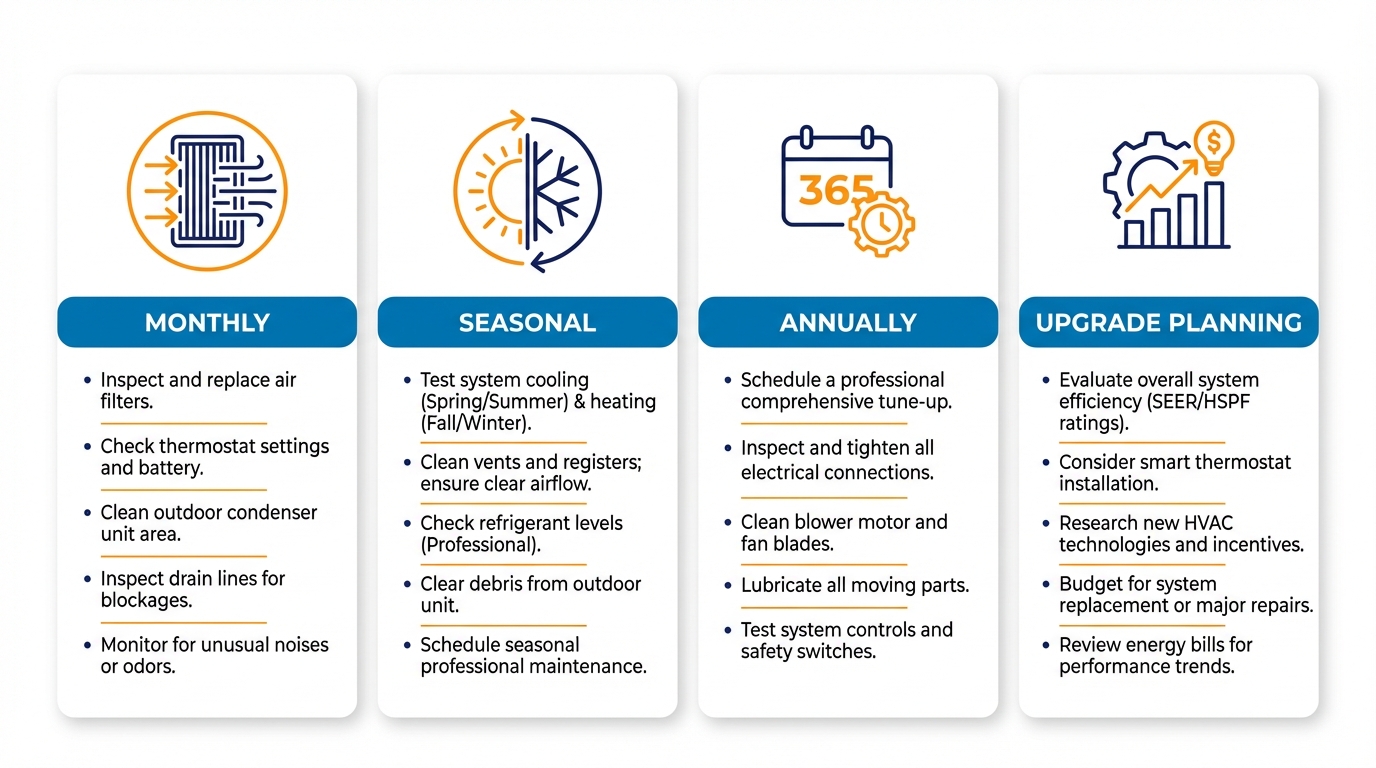
| Frequency | Action Items |
|---|---|
| Monthly | Check and replace air filter; inspect supply and return vents for obstructions; monitor thermostat schedule accuracy; listen for unusual system noises |
| Seasonal (before summer and winter) | Schedule professional HVAC maintenance; clear space around outdoor condenser; inspect attic for visible insulation gaps or duct disconnections; review weatherstripping on exterior doors |
| Annually or as needed | Evaluate duct sealing condition; assess attic insulation depth and coverage; test airflow balance between rooms; consider air quality testing if indoor air feels stale or dusty |
| Upgrade planning | Compare system age and repair history against replacement cost; check insulation and air sealing before sizing new equipment; review SEER2 ratings and available tax credits; get a professional assessment |
This checklist turns general advice into a repeatable action plan. Homeowners who follow it consistently tend to catch small problems before they become expensive ones, maintain better indoor comfort, and get longer, more efficient service life from their HVAC equipment.
Ready to take the first step? Clean Air Dallas Pro offers professional duct cleaning, insulation, and airflow services across the Dallas area.
Frequently Asked Questions
Heat naturally rises, and in Dallas homes the upper floor is closer to a superheated attic. If attic insulation is thin, radiant heat transfers directly into upstairs rooms. Duct runs serving the second floor are often longer and may pass through the hottest part of the attic, losing cooled air along the way. Limited return airflow on the upper level compounds the problem. Improving attic insulation, sealing duct joints, and adding return air paths are the most effective corrections.
Yes, but indirectly. Ceiling fans cool people through a wind-chill effect, not by lowering the room temperature. According to the U.S. Department of Energy, using ceiling fans allows homeowners to raise the thermostat by about 4°F without losing comfort. The savings come from reduced AC runtime at the higher setpoint. Fans should be turned off in unoccupied rooms because they provide no cooling benefit to an empty space.
No. Duct cleaning removes accumulated dust, debris, and buildup from inside the ductwork, improving airflow and indoor air quality. Duct sealing closes gaps, cracks, and disconnections in the duct system to prevent conditioned air from escaping into unconditioned spaces. Both services improve HVAC performance, but they address different problems. A home may need one, the other, or both depending on the condition of the ductwork.
Look at performance trends rather than age alone. If the system requires increasingly frequent repairs, runs for extended periods without reaching the setpoint, cools unevenly, manages humidity poorly, or causes rising bills despite regular maintenance, it may no longer be operating efficiently. Systems older than 15 years are generally worth evaluating against current efficiency standards and available tax credit opportunities for qualifying replacements.
The U.S. Department of Energy recommends setting the thermostat higher than your comfort setpoint when you are away from home. For Dallas summers, raising the temperature while you are at work and using a programmable or smart thermostat to begin cooling before you return is the most efficient approach. Avoid setting the temperature very low when you get home—the system cools at the same rate regardless, so a lower setpoint just means longer runtime.
During peak cooling months in Dallas, monthly filter replacement is recommended due to high dust levels, pollen, and continuous system runtime. Homes with pets, recent construction nearby, or allergy-sensitive occupants may benefit from even more frequent checks. Always ensure the replacement filter fits snugly in its housing to prevent unfiltered bypass air from entering the system.
Ready to Improve Comfort and Lower Energy Costs in Your Dallas Home?
If your energy bills keep climbing, your rooms cool unevenly, or your system seems to run harder than it should, the next step is identifying where the inefficiency actually lives. Is it the ducts, the insulation, the filter, the thermostat habits, or the equipment itself? In most Dallas homes, it is a combination—and addressing the right issues first makes every improvement after it more effective.
Clean Air Dallas Pro helps homeowners across Dallas with professional duct cleaning, duct sealing, attic insulation, airflow testing, and indoor air quality services designed to improve both comfort and system performance. Contact Clean Air Dallas Pro to schedule an inspection or ask about a free estimate for your home.
What Dallas Homeowners Are Saying
“I had the pleasure of hiring this exceptional firm to clean my air ducts, and I am really pleased with the outcomes. Their team’s expertise in air duct cleaning is unparalleled. My indoor air quality has improved significantly as a consequence of their painstaking efforts.”
“This company was my first choice while searching for ‘air duct cleaning near me’. They are experts at cleaning ducts. Their versatility and dependability are unparalleled.”
“My expectations were surpassed by Clean Air Dallas Pro’s vent cleaning service. The crew completed the task with efficiency, and the procedure ran smoothly from beginning to end. My HVAC system’s efficiency and airflow started to alter right away.”

Clean Air Dallas Pro Team
The Clean Air Dallas Pro team serves homeowners across Dallas, TX, with professional air duct cleaning, dryer vent cleaning, attic insulation, and indoor air quality services. Located at 2710 Guillot St, Dallas, TX 75204, our locally focused team understands the unique challenges that Dallas heat and humidity place on residential HVAC systems. Contact us at [email protected] or call (214) 935-5058 to schedule service.